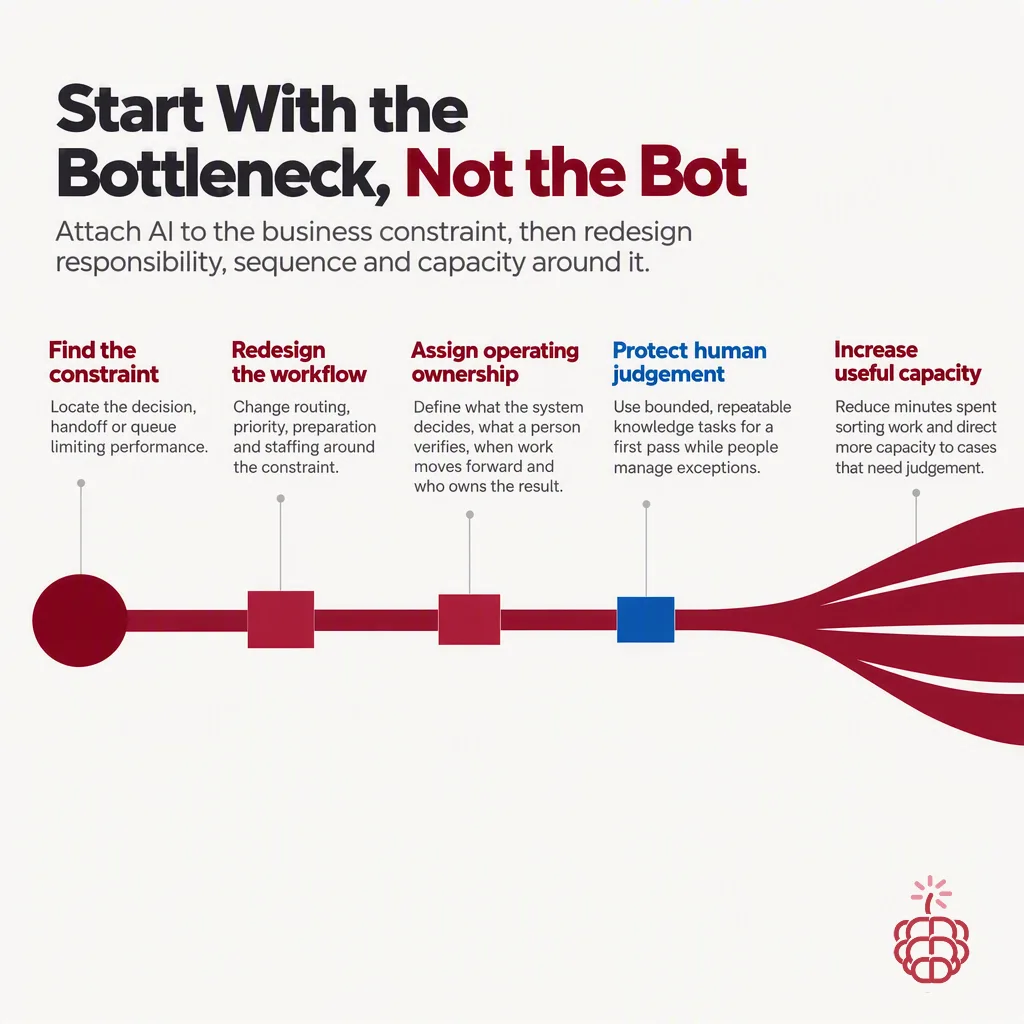
Most AI projects begin with a tool and end with a pilot. The commercially useful projects begin with a costly constraint, then change the workflow around it. That decision matters because a faster task does not necessarily create a faster business.
The pattern we keep seeing is simple: organizations ask where AI can be added before asking which decision, handoff or queue is limiting performance. That reverses the order of the work. A model may draft a response in seconds, but if the request still waits in the same queue, depends on the same fragmented records and follows the same escalation rules, the customer may experience no improvement.
This is why demonstrations are easier than operating capability. A demonstration proves that a model can produce an acceptable output. An operating capability assigns that output a place in the process. It defines what the system can decide, what a person must verify, when work moves forward and who owns the result.
The distinction is visible in customer service. Suppose Travelers Insurance uses AI to classify millions of customer communications, as reported by Ciklum. The value is not classification itself. It comes if classification changes routing, priority, preparation and staffing decisions across the service operation. The important outcome is fewer minutes spent sorting work and more capacity directed to cases that need judgement. The classification model is one component of that change, not the change on its own.

That logic also explains why narrow deployments often outperform broad “AI for everyone” programmes. Generative AI is a better fit for bounded, repeatable knowledge tasks where it can handle a first pass and people can manage exceptions. Applying it to a defined step makes performance easier to measure and failure easier to contain. Ciklum’s review reaches a similar conclusion: the organisations seeing measurable returns redesign workflows around AI rather than layering it onto processes built for manual execution.
The strongest objection is that problem-first language can sound too conservative. It may encourage companies to optimize today’s process when AI could make the process unnecessary. That objection is valid. A poorly framed problem can preserve obsolete work. “Our agents need faster answers” may be less useful than “why do agents answer this question at all?”
So the starting point should not be a task. It should be the business constraint and the decision behind it. Is the cost caused by searching, approving, routing, reconciling or responding? Which part requires judgement, and which part exists because the organisation has never redesigned the handoff?
Our view is not that technology is secondary. It is that technology becomes economically legible only when attached to a change in responsibility, sequence or capacity. The real AI strategy is therefore less about selecting the most impressive model than deciding which work should disappear, which decisions should improve and where human attention is still worth its cost.
That is an organisational choice. The companies that make it well will not simply have more AI in their operations. They will have fewer queues, clearer ownership and more capacity for the work that cannot be reduced to a prediction.