
Most organisations do not need another AI tool to begin creating value. They need to resolve a business decision that has been deferred, obscured or spread across too many owners. That changes the first investment question from “Which platform should we buy?” to “Which decision must become faster, cheaper or better controlled?”
The pattern we keep seeing is simple: a tool is easier to discuss than a decision. A procurement team can compare features. An IT team can assess security. A vendor can demonstrate a polished workflow. None of this answers whether the organisation is willing to change who decides, what evidence they use or how much risk they will accept.
That distinction matters because AI creates capacity only when it enters a live operating choice. Otherwise, it adds another surface for experimentation while the underlying queue remains intact. McKinsey’s 2026 global survey found that employees commonly report better individual productivity and decision-making, while enterprise-level financial impact remains much less widespread. The gap is not proof that AI fails. It suggests that personal assistance is easier to obtain than organisational change.
The mechanism is usually ownership. A delayed decision often has no agreed threshold, no accountable executive or no clean path from evidence to action. AI can summarize the evidence, predict likely outcomes or prepare recommendations, but it cannot resolve competing mandates. In some cases, it makes the problem more visible by producing plausible answers that different teams interpret differently.
Consider a procurement director whose company has a growing backlog of supplier renewals. Finance wants lower cost, operations wants continuity and legal wants tighter terms. The company could buy an AI procurement assistant to compare contracts and flag anomalies. That may reduce review time. But the larger gain comes only after the leaders agree which renewals can be auto-approved, which require negotiation and who owns an exception.
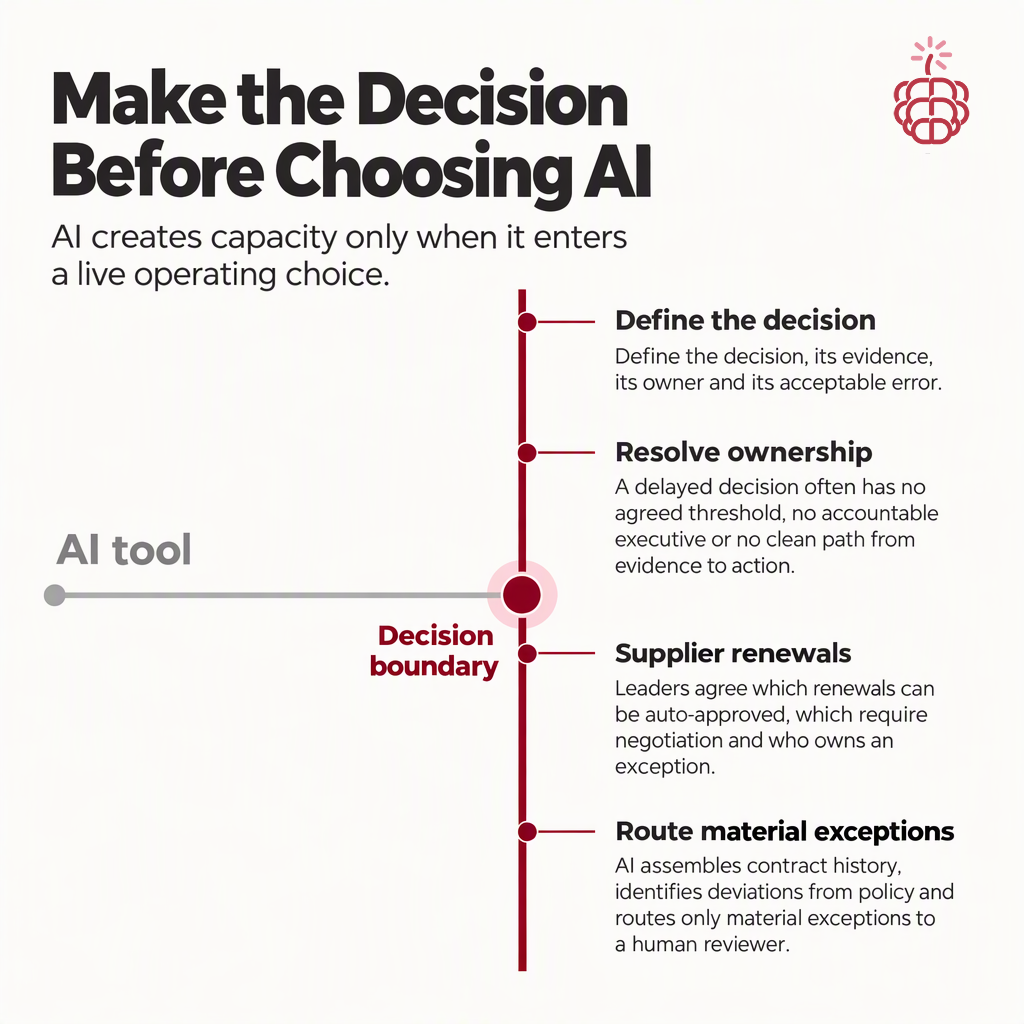
Once that decision is made, the technology has a defined job. It can assemble the relevant contract history, identify deviations from policy and route only material exceptions to a human reviewer. The workflow becomes smaller, not merely faster. Senior staff spend less time reading routine files and more time handling the negotiations that require judgement. The cost improvement is a consequence of narrowing human attention to the decisions that warrant it.
The strongest objection is that organisations sometimes must choose a tool before they know the exact decision. A general-purpose assistant can be a reasonable way to learn what is possible, especially where the cost and risk are low. But a demonstration is not operating capability. Bain’s recent analysis similarly argues that process redesign and organisational factors, rather than model capability alone, are the main barriers to scaling enterprise AI.
Our view is not that tool selection is irrelevant. It is that selection should follow a decision boundary. Define the decision, its evidence, its owner and its acceptable error. Then test whether a tool improves that path without creating new review, security or accountability burdens.
This reframes AI adoption as an organisational choice. The scarce resource is not access to models. It is the willingness to make decisions explicit enough for people and systems to act on them. The companies that gain lasting capacity will not necessarily buy the most capable tool. They will be the ones prepared to stop postponing the decision the tool was meant to help them make.