
The first commercial problem many companies should solve with AI is not content generation or automation. It is the wasted capacity created when employees cannot find trusted information quickly. That changes the investment decision: improve access to existing knowledge before adding another system that produces more of it.
The pattern we keep seeing is uncomfortable. Companies describe transformation as a front-office or workflow problem, while employees lose time searching shared drives, collaboration tools, email and specialist applications for answers that already exist. The search box is visible, but the operating cost is hidden in repeated questions, duplicated work and decisions made from whichever document appears first.
This matters because information access changes decisions, not just speed. A service manager who can find the current contract terms, approved workaround and history of a similar incident can resolve a customer issue with less escalation. A manager who cannot find them asks another expert, waits, or takes a defensible guess. The difference is not a better user experience. It is the number of decisions an organization can make without adding headcount.
Research and industry analysis commonly estimate that knowledge workers spend roughly one-fifth of their working time searching for and gathering internal information, although the exact figure varies by role and company. Even that estimate understates the cost when people must also decide whether a result is current, approved and safe to use. Poor findability is therefore a governance problem as much as a retrieval problem. Fragmented permissions, inconsistent naming and obsolete documents limit what any search system can return with confidence.
Consider a manufacturer whose field technician is troubleshooting a failed component. The relevant installation guide sits in a document repository, a later service bulletin is in a team workspace, and the customer’s configuration is recorded in a service system. A conventional search may return all three without showing how they relate. A permission-aware retrieval layer can present the technician with the applicable guidance, identify the newer bulletin and link the answer to its sources. The useful outcome is not an impressive response. It is fewer calls to engineering and a faster, better-supported repair decision.
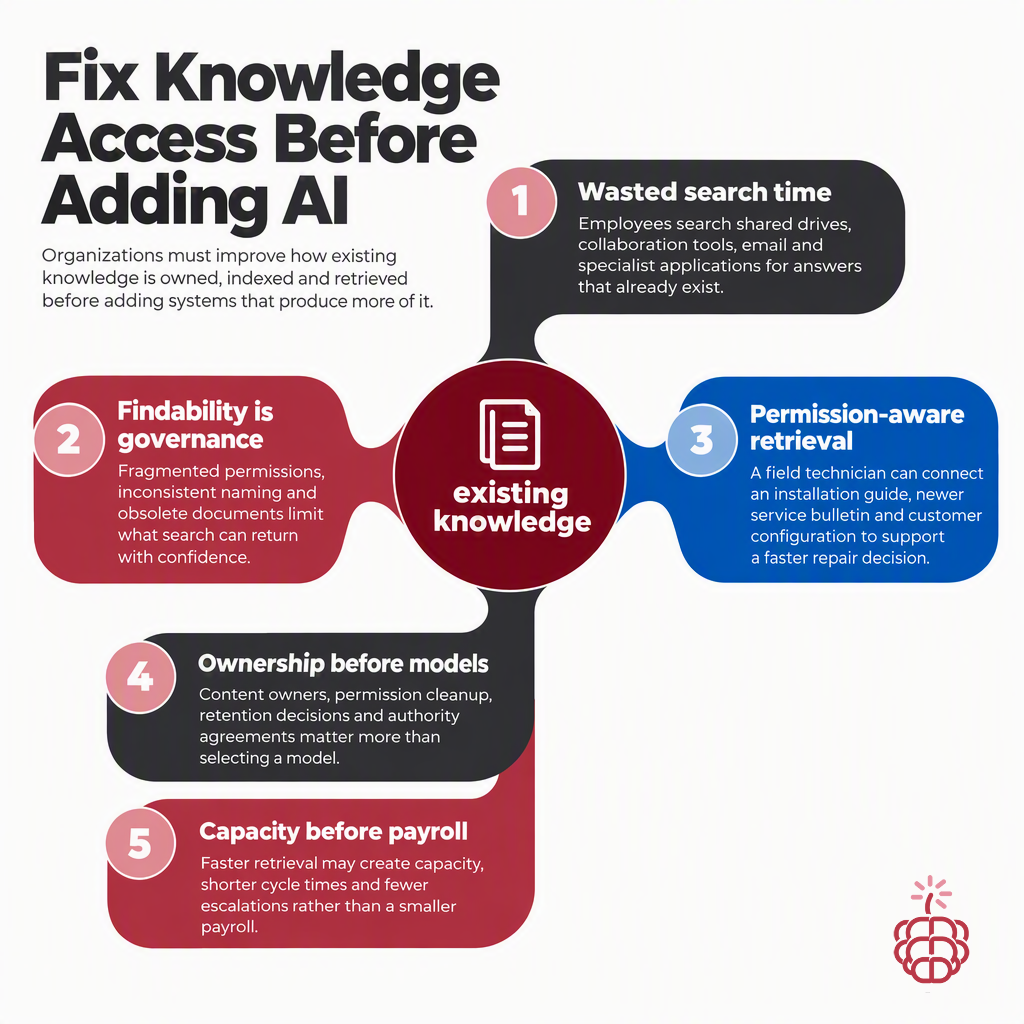
The strongest objection is that search projects are tedious. They require content owners, permission cleanup, retention decisions and agreement about what counts as authoritative. That objection is correct. A polished AI interface placed over unmanaged content can increase risk by making an uncertain answer sound settled. The difficult part is usually not selecting a model. It is assigning ownership to the information the model is expected to use.
This also limits the business case. Faster retrieval does not automatically create savings if employees simply fill the recovered time with more work. The nearer-term benefit may be capacity, shorter cycle times or fewer escalations rather than a smaller payroll. McKinsey’s latest survey reports that many employees believe AI improves individual productivity and decision-making, while enterprise-level financial impact remains less widespread. That gap is a warning against treating demonstrations as proof of operating value.
Our view is simple: search is not the low-ambition alternative to AI transformation. It is often the prerequisite that makes later automation trustworthy. The organizations that fix how knowledge is owned, indexed and retrieved are not just helping people find documents. They are deciding which work can be done confidently by fewer people, closer to the customer, with less organizational memory trapped in private conversations.