
Housing organizations do not lack ideas. They lose time finding the right project, precedent, approval path or lesson inside a fragmented body of public and internal knowledge. The commercial value of an AI guide is therefore not that it can answer questions; it is that it can shorten the path from a question to a defensible next decision.
That distinction matters in a sector where collaboration is part of delivery, not a side activity. Housing Development Consortium describes its work in terms of helping organizations connect and collaborate on issues affecting affordable housing. Its Vancouver innovation tour similarly centres on site visits, expert conversations and shared lessons that can inform legislation, planning and development. The recurring problem is not the absence of information. It is the cost of locating and interpreting information when the decision is live.
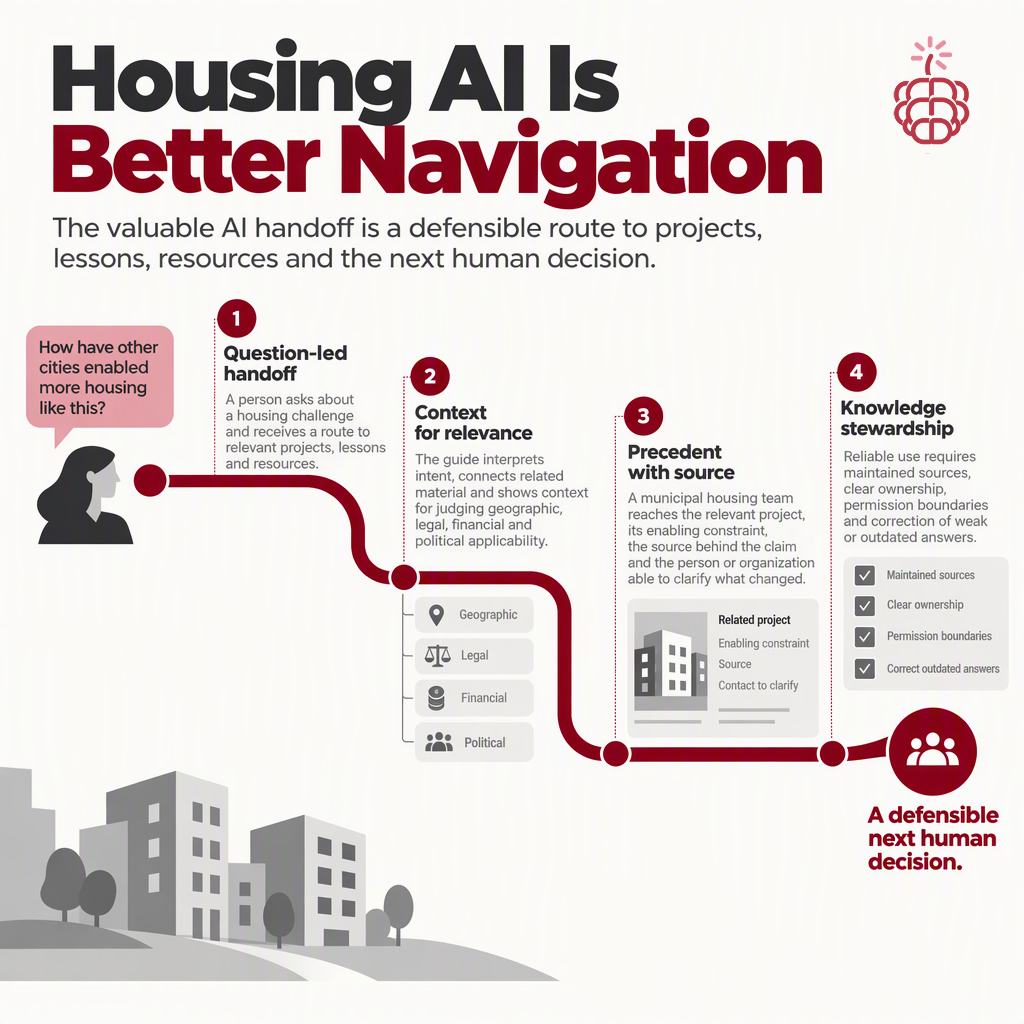
A question-led tool such as Charlie is interesting for this reason. Its useful unit is not the response. It is the handoff: a person asks about a housing challenge and receives a route to relevant projects, lessons and resources. That can reduce the first layer of research and make institutional knowledge easier to approach. It may also change who participates. People who would not know which organization, document or expert to contact can begin with the problem they are trying to solve.
The mechanism is simple but easy to underestimate. A conventional search system returns documents. A useful guide has to interpret intent, connect related material and show enough context for the user to judge relevance. That last requirement is decisive. In housing, a project can be geographically close yet legally, financially or politically inapplicable. A confident but poorly grounded answer would create more review work, not less.
Consider a municipal housing team investigating whether a proposed development resembles an earlier affordable housing project. The valuable outcome is not a polished explanation of that project. It is a tighter working path: the relevant precedent, the constraint that made it viable, the source behind the claim and the person or organization able to clarify what has changed. The team still makes the decision. It spends less time reconstructing the context.
This is also why a compelling demonstration should not be confused with an operating capability. A public-facing guide can show that information retrieval feels easier. Reliable use requires maintained sources, clear ownership, permission boundaries and a way to correct weak or outdated answers. The difficult part is usually not producing a fluent response. It is deciding what the system is allowed to say, how it signals uncertainty and who improves the underlying knowledge when policy or project conditions change.
The strongest objection is that housing decisions are too complex to delegate to an AI interface. That objection is valid, but it points to a narrower and more useful role. The system should not replace professional judgement or compress a contested decision into a recommendation. It should improve the quality and speed of the work before judgement: orientation, comparison, evidence gathering and referral.
Digital tools are increasingly being discussed alongside industrialized construction, automated site analysis and digital permitting as ways to address housing supply and affordability. Our view is that navigation deserves equal attention. Before an organization can build faster, it often has to learn faster from what is already known.
The larger implication is organizational. When knowledge becomes easier to find and question, expertise is less trapped in individual memory or specialist networks. AI then changes capacity without pretending to remove accountability. The measure of success is not whether the guide sounds intelligent. It is whether the next human decision becomes better prepared, less repetitive and easier to defend.