
Buying AI licences does not create operating capacity. The commercial question is whether an existing workflow becomes faster, cheaper or better decided on Monday morning. That should change the first implementation decision: start with a live piece of work, not a broad adoption campaign.
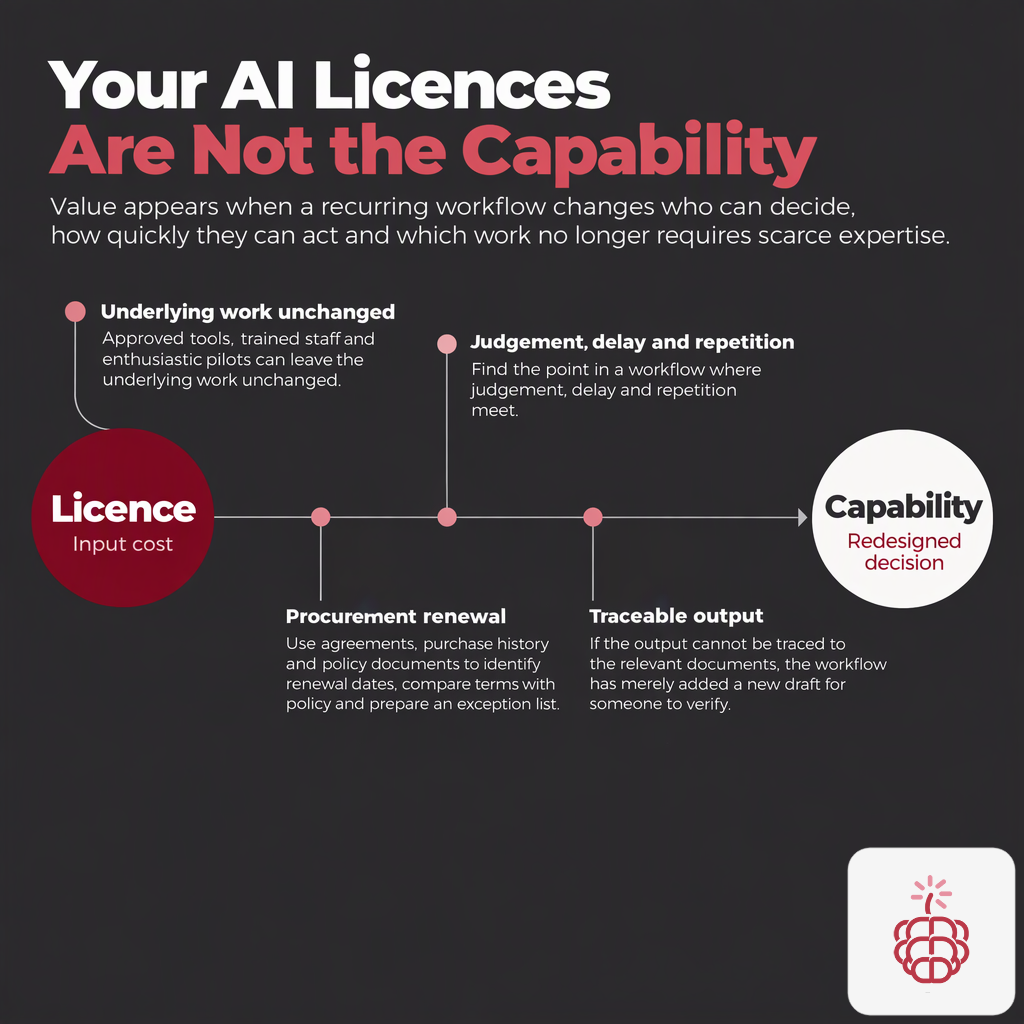
The pattern we keep seeing is a gap between access and use. An organization can have approved tools, trained staff and enthusiastic pilots while the underlying work remains unchanged. Public research reinforces the distinction: measures of AI adoption vary widely depending on whether they count firms, employees or individual usage. Exposure to AI is not the same as institutional capability.
This matters because a licence is an input cost, while value appears only when work moves differently. A model may draft a response, summarize a file or answer a question. Those demonstrations are useful, but they do not prove that anyone can rely on the output, that the right data is available, or that the result enters the process without creating another review queue.
The difficult part is usually not selecting a model. It is finding the point in a workflow where judgement, delay and repetition meet. That point gives the organization something concrete to change and something credible to measure. It also exposes the controls required: who owns the decision, which information can be used, what must be checked and what happens when the system is wrong.
Consider a procurement manager handling supplier renewals. The team already has the agreements, purchase history and policy documents in its existing systems. An AI tool might identify renewal dates, compare terms with policy and prepare an exception list. The useful outcome is not a polished summary. It is that the manager spends less time searching and more time deciding which suppliers need negotiation, escalation or replacement. If the output cannot be traced to the relevant documents, the workflow has not improved. It has merely added a new draft for someone to verify.
That example also shows why broad licence adoption can disappoint. The business may report that the tool is available and that employees use it, while procurement still carries the same deadlines, handoffs and risk. The apparent adoption is real, but the operating change is absent. Research on enterprise adoption similarly points to uneven institutional readiness, including gaps in formal processes, training, data preparation and accountability.
The strongest objection is that employees should be allowed to discover useful applications themselves. They should. Bottom-up experimentation can reveal work that central teams would miss. But discovery is not deployment. An individual shortcut becomes a business capability only when its data access, quality checks, ownership and place in the workflow are made explicit.
Our view is therefore narrower than “use the licences more.” Choose one recurring workflow, define the decision it should improve, and test whether the surrounding process changes. If it does, the organization has learned where further investment may matter. If it does not, more access will mostly produce more isolated activity.
The larger shift is organizational. AI spending becomes consequential when it changes who can decide, how quickly they can act and which work no longer requires scarce expertise. The licence is visible. The redesigned decision is where the value resides.